VGA to RGB Sync-On-Green adapter
Why
I wanted to use a SiliconGraphics GDM-17E11 monitor on my Sun Ultra 10. My Syn Ultra 10 has a vga output, and the monitor has a 13W3 input, which requires Sync-On-Green. That's why I needed to find a way to convert VGA to RGB SyncOnGreen.VGA:
Usually, there are 5 important signals coming out from a VGA card. The colors (Red, Green,Blue) and Sync (H-Sync and V-Sync). The voltage on the color signals is proportional at the brightness of the color at a given moment. The Sync signals are generally kept high, with short low pulses when retrace must occur.
Composite Sync (C-SYNC):
Some monitors support or need Composite Sync (C-Sync). C-Sync is both H-Sync and V-Sync pulses combined together with a simple circuit(dont try connecting the 2 wires together). The monitor can differentiate between H-Sync and V-Sync by looking at the pulse width. The V-Sync pulse is longer. Old sun monitors required C-Sync, and I guess that's why C-Sync comes out of my Ultra 10 instead of V/HSync.
For some info about how to convert H/V-Sync to C-Sync, consult this page: VGA to RGB + composite sync -converter
Sync-On-Green:
Some monitors requires the C-Sync pulses to be combined with the Green color signal. That's the case with my GDM-17E11. It can be done with a very simple circuit, as demonstrated on this page: Circuit for converting spearate sync signals to SYNC-in-GREEN. Most schematics includes a part to combine V and H sync, but sometimes it is not necessary. Some video cards can be programmed to output C-Sync on the H-Sync pin (+csync). I case you are wondering, the sync pulse does not interferate with the green signal because the pulses always occur at the end of a line or at the bottom of the screen.
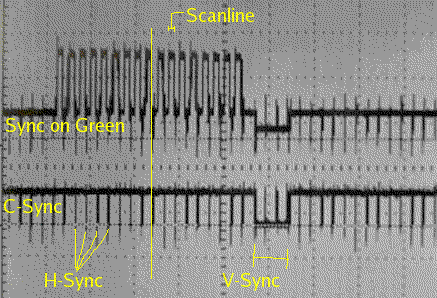 As you can see on the picture above, it is easy to recognize which pulse is H-Sync and V-Sync. When I took
this sample, my screen was totally black, but there was a small taskbar in the bottom. We can see how
the task bar effects the voltage of the green signal. We can also confirm that the sync pulses occur
at the end of a line by looking at the vertical line I drew.
As you can see on the picture above, it is easy to recognize which pulse is H-Sync and V-Sync. When I took
this sample, my screen was totally black, but there was a small taskbar in the bottom. We can see how
the task bar effects the voltage of the green signal. We can also confirm that the sync pulses occur
at the end of a line by looking at the vertical line I drew.
Schematic
I chose to use the schematic I found on this page: Circuit for converting spearate sync signals to SYNC-in-GREEN .Since I knew my Sun was already outputting C-Sync, I was able to simplify this already simple schematic:
Original schematic:
             100 uF
          ! !
Green ----! !---------------------------------
         -! !+                                !
                                              !
                                     680E     !
                     BC548                    !
HSync -------------      __---------/\/\------o---------  CSync on Green
                    \     /!
                     \   /
                   ---------
                       !
               1k      !
VSync ----/\/\----------
Simplified Schematic:
             100 uF
          ! !
Green ----! !---------------------------------
         -! !+                                !
                                              !
                                  680 ohms    !
                                              !
HSync/CSync ------------------------/\/\------o---------  CSync on Green
The transistor used to combine to add V-Sync to the H-Sync
is not necessary anymore. The remaining components are
necessary.
2012-04-14. Dominique Masson sent me another version:
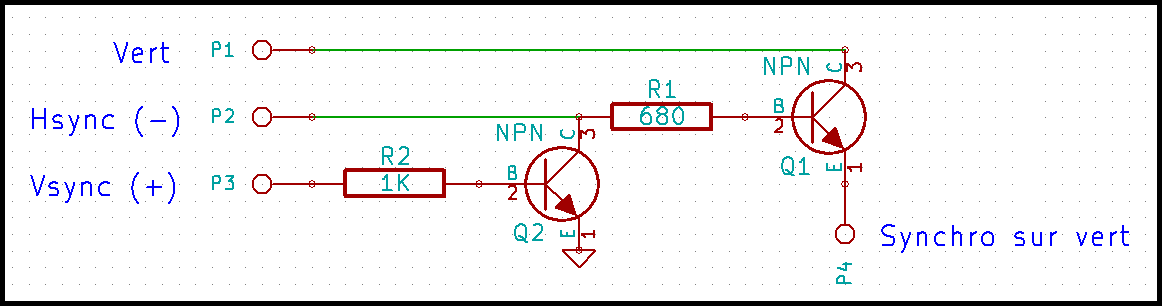
		This one works with +vsync and -hsync.

		Transistor Q2 is chopping -hsync using +vsync to obtain -csync.

		Transistor Q1 only lets the green pass when -csync is active,
		generating Sync on green.


		Tested on a B/W tv using Powerstrip. The results were quite satisfactory.
Pictures
 I reused the cable from an old VGA monitor. It is important to use a good quality cable, otherwise you might
obtain a blurry image, noise, etc...
I reused the cable from an old VGA monitor. It is important to use a good quality cable, otherwise you might
obtain a blurry image, noise, etc...The picture shows the test cable. Better test before tightly packing everything in a small case...
 Fortunately, the components fitted inside the connector casing.
 Here is the complete cable.
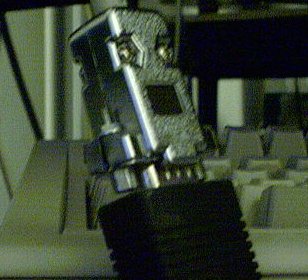 The Sync-On-Green output of the finished cable, in use.
Disclaimer
I cannot be held responsible for any damages that could occur to you or your equipment while following the procedures present on this page. Also, I GIVE ABSOLUTELY NO WARRANTY on the correctness and usability of the informations on this page. Please note, however, that the procedures above have worked in my case without any damages or problems.Now you cannot say that I did not warn you :)